Data analysis โ€“ all pages

Start

SInES Tools

Projects and systems

Data analysis โ€บ SInES Tools โ€บ Sound analysis

SInES Tools ยท sound

Sound analysis

Audio features turn a recording into numbers over time: loudness, brightness, noise, pitch, vibrato, onsets. Use the same microphone and distance when you compare players or conditions.

Basic features and timbre

Signal Analysis Tool I is the standard entry; Tool II and Spectral Features add independent descriptors.

Signal Analysis Tool I โ†—

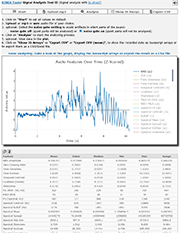
The standard entry: about 50 audio features over time (meyda.js) โ€“ RMS, energy, spectral centroid (brightness), zero-crossing rate, spectral flatness, MFCC and more.

Input
wav/mp3, also many files
Output
features per time frame, absolute or z-standardised (CSV)
In Healthy Strings
Loudness and brightness per task; comparing players or recordings.
Watch out
Keep microphone and distance constant โ€“ otherwise you compare rooms and phones, not playing.
Signal Analysis Tool II โ†—

A second, independent feature library (JS-Xtract) with partly different descriptors (tristimulus, irregularity, inharmonicity, spectral crest).

Input
wav/mp3
Output
features per time frame (CSV)
In Healthy Strings
Cross-checking results of Tool I.
Spectral Features โ†—

Timbre analysis with many global values: attack time, loudness, dynamic complexity, dissonance, inharmonicity, pitch salience (essentia.js).

Input
wav/mp3, batch
Output
values per file and over time (CSV)
In Healthy Strings
Describing the tone of a task or excerpt.

Pitch, intonation and vibrato

For the scales, the vibrato task and the repertoire excerpts.

Pitch Estimator (CREPE) โ†—

Fundamental frequency over time with the CREPE neural network (ml5.js).

Input
wav/mp3, one voice
Output
F0 per time frame (CSV)
In Healthy Strings
Intonation curves of scales and the repertoire excerpts.
Watch out
Monophonic only; double stops confuse it.
Violin Intonation (VIP) โ†—

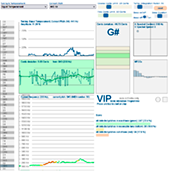
Checks intonation while playing: tuning, temperament and timbre, live or from a file.

Input
microphone or audio file
Output
deviations in cents, displays
In Healthy Strings
Teaching and self-checks; intonation tasks of the protocol.
Modulation Transfer โ†—

Analyses vibrato, tremolo, jitter and shimmer and saves them as numbers (and can transfer them to other sounds).

Input
wav/mp3
Output
modulation rate and depth (CSV)
In Healthy Strings
Vibrato rate and depth in the vibrato task (T13).
Pitch & Tempo Analyser โ†—

Polyphonic pitch, chords, key and tempo (essentia.js), MIDI export.

Input
wav/mp3
Output
pitch, chords, BPM, MIDI
In Healthy Strings
Checking tempo and key of the excerpts.

Timing and segmentation

Onsets, tempo and cutting long recordings into tasks or notes.

Pitch & Onset Tool โ†—

Pitch, tempo and note onsets (aubio.js).

Input
wav/mp3
Output
onset times, F0, BPM (CSV)
In Healthy Strings
Finding note and bow-change times; checking the metronome grid of part 1.
Tempodrom โ†—

Multi-band rhythm analysis that estimates the tempo as humans perceive it.

Input
wav/mp3
Output
BPM and rhythm curves
In Healthy Strings
Tempo of the free-timing excerpts (part 2).
Sound Segmenter โ†—

AI sample slicer: cuts recordings into events or notes, with automatic pitch detection, and downloads them in a batch.

Input
wav/mp3
Output
one wav file per segment
In Healthy Strings
Cutting a protocol recording into tasks โ€“ check every cut.

Level, loudness and noise

Absolute levels need a calibrated microphone; with phones, compare relative values only.

dB Analyser โ†—

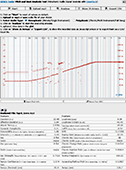
Sound pressure and loudness from calibrated recordings: dB SPL from dBFS, dBA/dBB/dBC, LAeq, LUFS, sone, phon.

Input
wav from a calibrated microphone
Output
level values (Excel)
In Healthy Strings
Comparing dynamics only when the microphone was calibrated.
Watch out
Phone microphones are not calibrated โ€“ use relative values.
Zwicker Loudness Meter โ†—

Loudness after ISO 532B (Zwicker).

Input
wav
Output
loudness in sone over time
In Healthy Strings
Perceived loudness of dynamics tasks.
Harmonicity Analyser (HNR) โ†—

Separates harmonic and noisy parts of a sound and computes the harmonic-to-noise ratio.

Input
wav/mp3
Output
HNR over time (CSV)
In Healthy Strings
Noise in the tone, e.g. bow pressure and contact point.
Batch Audio Loudness Normalizer โ†—

Aligns the perceived loudness of many files for listening experiments.

Input
wav/mp3 files
Output
normalised files
In Healthy Strings
Preparing clips for listener ratings.

SInES Tools: Christoph Reuter and the SInES team, Department of Musicology, University of Vienna โ€“ free, MIT licence, everything runs in your browser, no data leaves your computer. Full catalogue (about 120 tools): sinestools.univie.ac.at. Cite: Reuter, C., Czedik-Eysenberg, I., Cui, A.-X., Ambros, S., Klooss, F., Feller, G., Schachner, I., Roos, M., Lindenbauer, H., Li, H., & Bertsch, M. (2026). SInES Tools, helpers, visualizers as your scientific realizers. In Fortschritte der Akustik โ€“ DAGA 2026 (pp. 1002โ€“1005). https://doi.org/10.71568/daga2026.094
โ†‘